
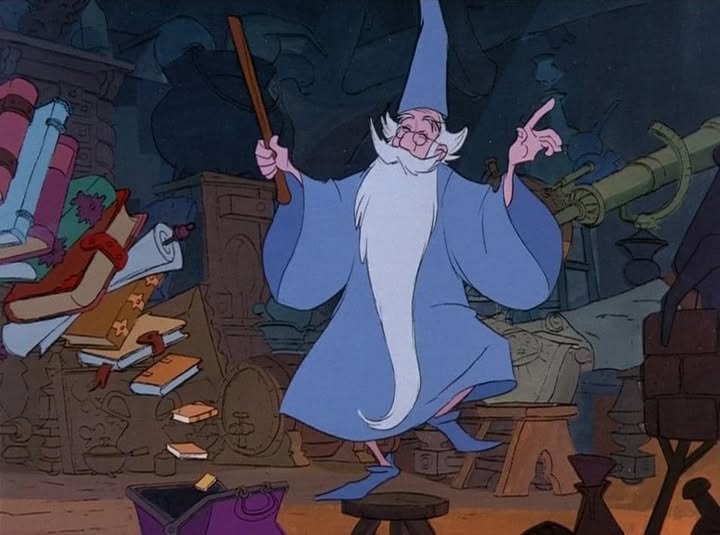
Nel romanzo The Once and Future King (1958) di T.H. White, l’opera che ha ispirato il cartone animato Disney La spada nella roccia, c’è una scena apparentemente semplice quanto profonda: il vecchio mago Merlino e il giovane Artù, seduti a parlare. Non c’è nessuna battaglia, nessun viaggio epico. Eppure è uno dei momenti più potenti dell’intero libro.
Siamo nella prima parte del romanzo, “The Sword in the Stone” (libro I). Merlino sta formando Artù come futuro re, ma non con le armi: con le idee. E quando Artù si mostra abbattuto, il mago risponde con queste parole.
“La cosa migliore da fare quando si è tristi”, replicò Merlino, cominciando a soffiare e sbuffare, “è imparare qualcosa. È l’unica cosa che non fallisce mai. Puoi essere invecchiato, con il tuo corpo tremolante e indebolito, puoi passare notti insonni ad ascoltare la malattia che prende le tue vene, puoi perdere il tuo solo amore, puoi vedere il mondo attorno a te devastato da lunatici maligni, o sapere che il tuo onore è calpestato nelle fogne delle menti più vili. C’è solo una cosa che tu possa fare per questo: imparare. Impara perché il mondo si muove, e cosa lo muove. Questa è l’unica cosa di cui la mente non si stancherà mai, non si alienerà mai, non ne sarà mai torturata, né spaventata o intimidita, né sognerà mai di pentirsene. Imparare è l’unica cosa per te. Guarda quante cose ci sono da imparare.”
(Mago Merlino, The Once and Future King, T. H. White)
White costruisce Merlino come un personaggio che vive il tempo al contrario: ricorda il futuro e dimentica il passato. Per questo ha una visione distaccata e panoramica della vita. Sa già cosa accadrà ad Artù, sa le sofferenze che lo aspettano e il suo messaggio è preciso: di fronte alla perdita, al dolore, alla sconfitta, l’unica risposta che non si può togliere è la conoscenza.
Ecco il passaggio originale in inglese:
“The best thing for being sad,’ replied Merlyn, beginning to puff and blow, ‘is to learn something. That is the only thing that never fails. You may grow old and trembling in you anatomies, you may lie awake at night listening to the disorder of your veins, you may miss your only love, you may see the world about you devastated by evil lunatics, or know your honour trampled in the sewers of baser minds. There is only one thing for it then – to learn. Learn why the world wags and what wags in it. That is the only thing which the mind can never exhaust, never alienate, never be tortured by, never fear or distrust, and never dream of regretting. Learning is the thing for you. Look at what a lot of things there are to learn – pure science, the only purity there is. You can learn astronomy in a lifetime, natural history in three, literature in six. And then, after you have exhausted a milliard lifetimes in biology and medicine and theocriticism and geography and history and economics – why, you can start to make a cartwheel out of the appropriate wood, or spend fifty years learning to begin to learn to beat your adversary at fencing. After that you can start again on mathematics, until it is time to learn to plough.”